

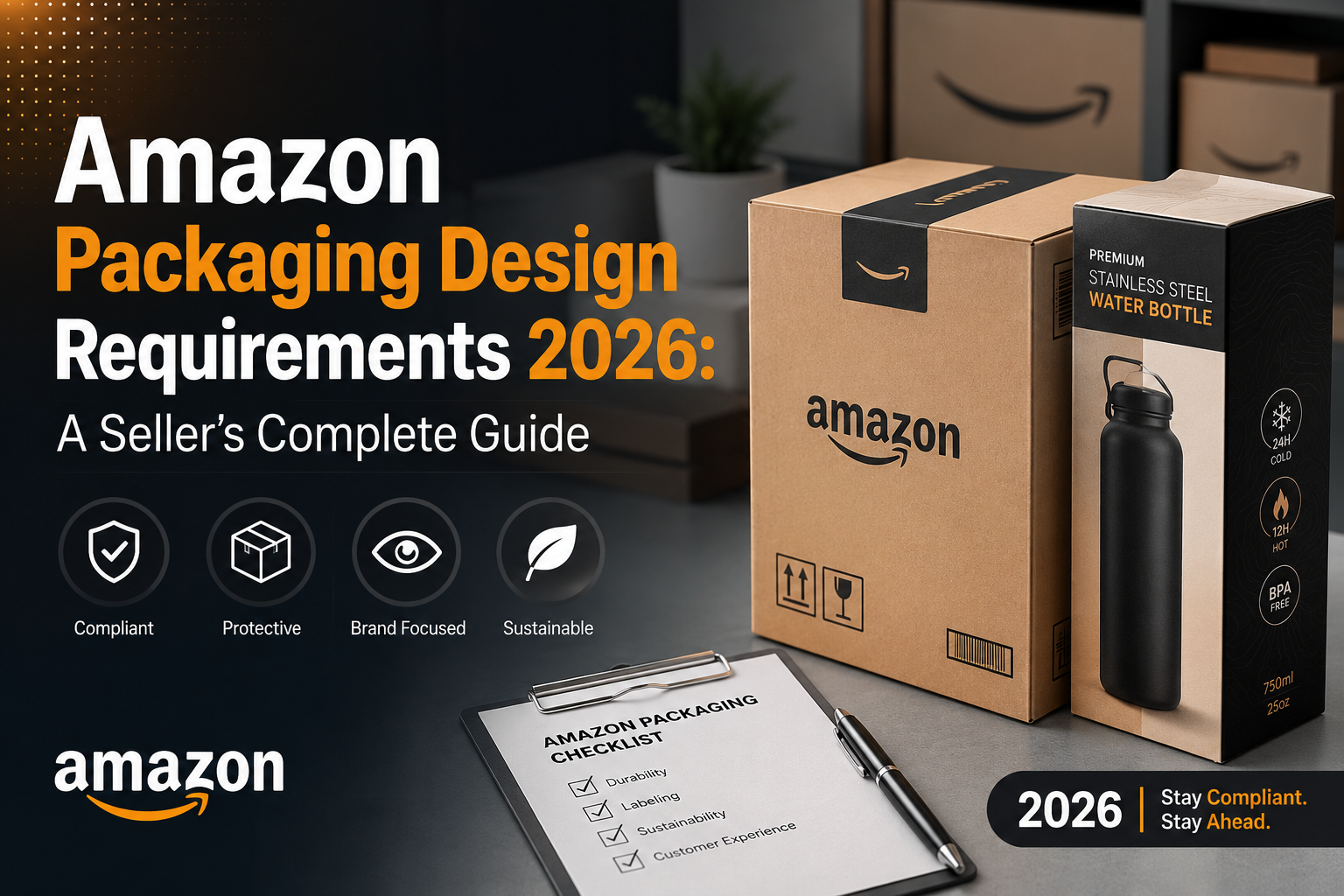
There’s a moment every Amazon seller dreads. You’ve spent weeks sourcing the product, days perfecting the listing, real money on inventory and ads — and then a single email lands in your inbox. Your shipment has been flagged. Fees are already being charged. And the box you were so proud of is now sitting in a fulfillment center, quietly draining your margin one unit at a time.
Here’s the uncomfortable truth about selling on Amazon in 2026: your packaging is either quietly protecting your profit, or slowly bleeding it. There’s no middle ground anymore. And most sellers don’t realize which side they’re on until the fee report shows up.
So let’s fix that. Grab a coffee — this is the guide I wish every seller read before their first shipment, not after.
🔑 Key Takeaways
- Amazon no longer fixes your mistakes. As of January 1, 2026, US prep and labeling services are gone — non-compliant units get charged, not corrected.
- Defect fees now run ~$0.32 to $5.72 per unit. On a 500-unit shipment, one repeated error can erase the whole batch’s profit.
- Every unit needs one clean, scannable barcode on a flat surface — old codes covered, thermal-printed, no exceptions.
- Boxes stay within 36 × 25 × 25 inches and under 50 lbs. Oversizing quietly pushes you into higher fee tiers.
- Poly bags must be 1.5 mil thick with a suffocation warning on any opening 5 inches or larger.
- Commingling ends March 31, 2026 — every seller’s inventory is now tracked separately.
- Good design is no longer a compromise. Amazon’s SIPP program lets branded packaging flow through compliant — if it’s built to spec.
The year Amazon stopped catching your mistakes
For years, Amazon played the safety net. Wrong barcode? They’d fix it for a small fee. Product needed a poly bag? They’d bag it. Fragile item packed loosely? They’d bubble-wrap it and send you a bill. It was expensive, but it was forgiving.
That era ended on January 1, 2026.
Amazon shut down its US prep and labeling services completely. No more fixing your barcodes. No more bagging your products. No more catching your mistakes before the customer does. Now, when inventory shows up wrong, it doesn’t get corrected — it gets penalized. Automatically. Defect fees now run anywhere from around $0.32 to $5.72 per unit depending on what went wrong.
Do the math on that. A 500-unit shipment with a repeating barcode error can quietly eat the entire profit on the batch before you’ve sold a single one. That’s not a rounding error. That’s your whole month.
And there’s more. Amazon is ending commingling — the old system where your stock got pooled with identical products from other sellers. From March 31, 2026, every seller’s inventory is tracked separately. If you’re brand-registered, you can lean on your own manufacturer barcodes. If you’re a reseller, every single unit needs its own FNSKU. No exceptions, no shortcuts.
The headline for 2026 is simple: packaging is now the most expensive thing to get wrong on Amazon. More than storage limits. More than late shipments. It quietly climbed to the top of the penalty list while most sellers weren’t looking.
If you’re brand new to all this, it’s worth ten minutes to watch Amazon walk through the basics themselves before we go deeper:
▶ Watch — Amazon FBA packaging, prep & labeling requirements (Seller University)
The requirements at a glance
Before we get into the why, here’s the what — the core rules every unit and every box has to satisfy, in plain language.
| Requirement | What It Means |
|---|---|
| Prep-free | Your item must arrive fully prepared and ready to sell. Amazon won’t touch it. |
| Scannable label | Each unit needs one visible, flat, machine-readable barcode (FNSKU for private label). |
| Sealed packaging | Anything that can spill, open, or come apart must be secured and sealed. |
| Drop-test approved | Packaging should survive a 3-foot drop on every side without damage. |
| No loose units | Bundles and components must be contained — nothing exposed or rattling. |
| Correct label placement | Labels go on flat surfaces — never on curves, corners, or openings. |
| Box weight limit | Under 50 lbs, unless it’s a single oversized item with the right lift label. |
| Box size limit | Stay within 36″ × 25″ × 25″, and no smaller than 6″ × 4″ × 1″. |
Keep that table handy — it’s the checklist your supplier should be working from too.
Getting the box right
Let’s start with the thing everyone underestimates — the box itself.
Amazon wants your standard cartons to stay within 36 inches long, 25 inches wide, and 25 inches tall, and under 50 pounds. That length limit is actually good news: it jumped from 25 to 36 inches back in mid-2025, which means long products — rolled mats, poles, panels, anything awkward — that used to trigger painful oversize handling can now often slip into a normal carton. If you’ve been shipping long items, it’s worth auditing your catalog; you might be paying oversize fees you no longer need to.
At the other end, don’t go too small either. Boxes need to be at least 6 by 4 by 1 inches and weigh around a pound, or they slow down at receiving. And if a carton lands somewhere between 33 and 50 pounds, slap a “Heavy Package” label on at least five sides — it’s a courtesy to the warehouse workers lifting it, and skipping it invites trouble.
But here’s the part that costs sellers the most, and almost nobody talks about it: an oversized box relative to your product isn’t just wasteful cardboard. It inflates your volumetric weight, and that can bump you into a higher fee tier on every unit you ship. A box that’s an inch too generous on each side is a tax you pay forever. Right-sizing your packaging to the product is one of the quietest, most reliable wins in the entire business.
The barcode: small sticker, big consequences
If the box is the body, the barcode is the heartbeat. It’s the only way Amazon actually knows what’s inside. And it’s where tiny mistakes cause the loudest problems.
Use an FNSKU where you can, rather than leaning on a bare UPC — it keeps your inventory yours, and protects you if a counterfeit ever shows up on your listing. Then follow three unglamorous but crucial rules. Make sure only one scannable barcode is visible, and cover any old manufacturer codes — two visible barcodes confuse the scanner, and a confused scanner flags your item as unscannable. Place the label on a flat, smooth surface, never wrapped around a bottle neck or folded across a seam. And print it on a thermal printer, not an inkjet — inkjet smears, and a smeared barcode is a defect fee with a delay on it.
None of this is exciting. All of it is the difference between inventory that flows and inventory that gets stuck. If you want to see exactly how the labeling and prep steps look in practice, this walkthrough covers it well:
▶ Watch — FBA packaging, prep & labeling in practice
Bags, fragility, and the details that get skipped
Some products need a little extra care, and Amazon is specific about it.
If your product has loose parts, fabric, soft surfaces, or anything that could leak, it needs a poly bag — and not just any bag. It should be at least 1.5 mil thick, transparent, and if the opening is five inches or wider, it needs a suffocation warning printed right on it. Fragile items have to survive a three-foot drop test, which is exactly as literal as it sounds — five drops, one on each side and one on a corner; if it can’t take the fall, it needs more cushioning or an outer box. And if you’re selling a set, say so clearly — a simple “sold as set, do not separate” — and seal it so nothing wanders off during handling.
One rule underneath all of this: your shipping carton has to be a proper six-sided corrugated box with sealed flaps. No open tops, no tubes, no soft mailers pretending to be boxes.
Where design stops being a compromise
Here’s where it gets interesting — and where most sellers are leaving money on the table without knowing it.
For a long time, sellers felt they had to choose. You could have compliant packaging or beautiful packaging, but trying to have both got your gorgeous custom box rejected at the warehouse. So people either shipped plain, forgettable boxes that quietly hurt their brand, or spent real money on premium packaging that got bounced because it wasn’t built to spec.
In 2026, that trade-off is finally dead — if you design it right from the start.
Amazon’s Ships in Product Packaging program (SIPP) lets your branded, custom-designed packaging flow straight through fulfillment without Amazon over-boxing it, and approved products can even earn a discount. Your beautiful box gets to stay beautiful and stay compliant. But — and this is the whole game — it only works when the design is engineered around the rules from the first sketch. The right dieline. Barcode and warning zones planned into the artwork instead of stamped on afterward. Print-ready files your manufacturer won’t butcher. Dimensions that never drift into an oversize tier.
This is the exact spot where sellers either lose money or make it. Get the design wrong and you’re paying to reprint, or paying oversize fees, or shipping something plain because “at least it clears.” Get it right and one package does two jobs at once: it sails through the fulfillment center, and it earns the click on a crowded product page. Compliance keeps your inventory moving. Design is what makes it sell. In 2026, they finally pull in the same direction — but only if someone builds them that way on purpose.
Before your next shipment leaves
Run through this in your head before any inventory ships, and you’ll dodge the vast majority of defect fees:
Box within 36 × 25 × 25 inches and under 50 pounds. Six sides, sealed flaps, proper tape. One clean FNSKU barcode on a flat surface, thermal-printed, old codes covered. Poly bag at least 1.5 mil with a warning if it needs one. Fragile items that pass the drop test. Sets labeled and sealed. Heavy-package labels on five sides if the carton is on the heavier end. And print-ready design files that actually match your approved dieline.
That’s it. Nine habits standing between you and a fee report you don’t want to read.
The bottom line
Amazon in 2026 doesn’t warn you gently anymore. It charges you, unit by unit, the moment something’s off — and it does it silently, buried in a report you might not check until the damage is done. The sellers who thrive are the ones who stopped treating packaging as the last box to tick and started treating it as core to the business.
Do that, and every shipment becomes a small act of profit protection. Your inventory clears. Your brand looks the part. And your margin stays yours.
If you’d rather not bet your inventory on a dieline that should work, this is exactly where a specialist earns their keep. I design premium, Amazon-compliant packaging and labels for private label and supplement brands — built to clear the fulfillment center and win on the product page, at the same time. Let’s make your packaging work twice as hard.
Written by Umair Arif — Premium Packaging & Brand Identity Designer specializing in Amazon packaging, supplement labels, and private label branding.